
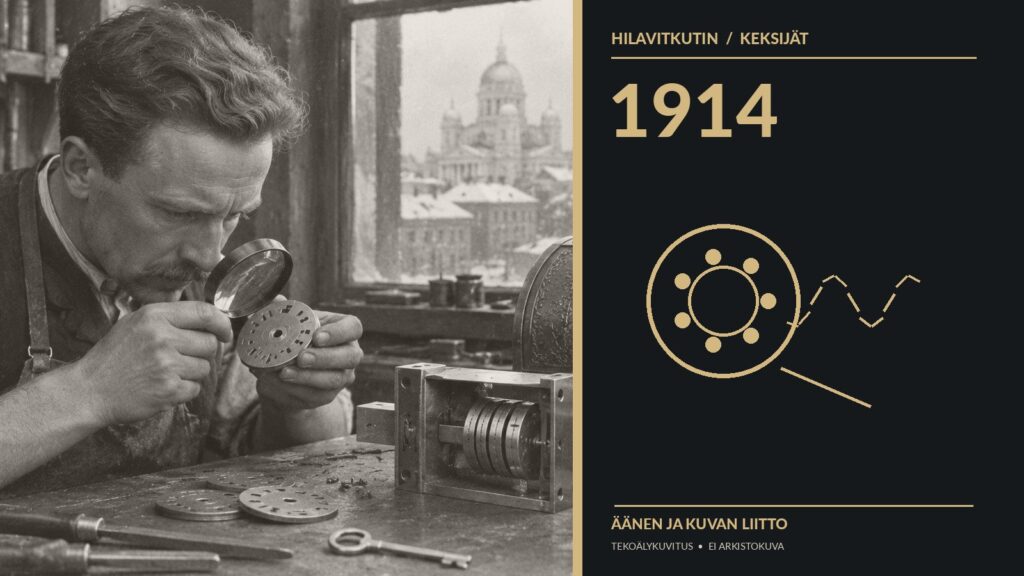
Eric Tigerstedt – the Finn who tried to give films a voice before Hollywood

Finnish inventors
When a cinema today fills with speech, music and explosions, sound feels like a given. A hundred years ago it was an outright nightmare for engineers. Eric Magnus Campbell Tigerstedt took on the problem at a time when many others were also trying to get moving pictures and sound to keep the same beat.
Films could already show – but not yet talk
Tigerstedt was born in 1887 in the Grand Duchy of Finland, then part of the Russian Empire, and his career took him to several countries. His work revolved above all around one question: how do you capture an actor’s voice and play it back so that the sound does not trail behind the picture like a late bus? Early films were often accompanied by a live musician. Once speech had to be included, you needed microphones, amplifiers, recording methods and working synchronisation. Tigerstedt researched all of them. He did not invent sound film on his own; many engineers in different countries were working on the same problem. His importance lies in being one of the early and exceptionally versatile developers.
Too many inventions for one man
A research publication from the University of Helsinki has gone through Tigerstedt’s patents and applications from 1912–1920. The range of topics is astonishing: sound recorded on a photographic track, synchronising a separate sound disc with the film, amplifiers, loudspeakers, microphones and recording experiments on steel wire and steel tape. According to the researchers, his career produced around 70 electrotechnical devices or methods and more than a hundred patents in various countries. The number speaks of diligence, but not yet of which solution won the market. A patent is a legal form of protection, not a receipt for commercial success.
So where did the breakthrough go?
Tigerstedt’s career was cut short: he died in 1925, only 37 years old. The breakthrough of the big film studios’ sound systems came only in the following years, and the history of the field is usually associated with larger companies and other inventors. It is tempting to tell the story of a Finnish genius whose invention was stolen. Such a claim, however, would need precise evidence. What can be verified is the scope of his early technical work, a career that ended early, and the fact that his name never became a commercial synonym for sound film.
Why he is still interesting
Tigerstedt is a reminder that even a major technological shift is made up of many smaller insights. Sound film was not born at the push of a button; it needed a whole system. The same goes for today’s artificial intelligence or virtual reality: rarely does a single device solve everything. Tigerstedt’s story is more interesting without a national hero myth: a Finnish inventor genuinely took part in an international race that changed the world – and managed to try out technical paths that later generations continued.
What did he leave behind?
Patents, research material and a reminder that combining sound and picture was once a radical innovation. Incidentally, when a modern streaming player starts to stutter and the sound lags behind, Tigerstedt’s century-old problem is still familiar. Today we call it a technical glitch rather than a revolutionary research project.
What was an inventor’s working day like back then?
Today a piece of software can gain a new feature through an update. In Tigerstedt’s day even a small improvement could require a different microphone, new electrical components and a completely rebuilt test circuit. A device that worked in the laboratory was not yet guaranteed to survive a long cinema screening or spread to other countries. That is what makes early patents interesting to read: their descriptions show a step-by-step effort to turn one uncertain experiment into a repeatable system. The right question is not only who was first, but which part of the whole was ready for use.
What should readers look up next?
Alongside Tigerstedt’s patents and technical experiments, it is worth reading the history of the first sound systems for film. It shows how early microphones, amplifiers, recording methods and projectors developed side by side. His international career is also part of the story. Finland’s borders did not confine the inventor’s work, but international networks alone did not solve the problems of production, funding and industrial cooperation.
One thing worth remembering
An early pioneer of sound film – not the sole inventor of sound film. A large number of patents does not mean an equally large market.
Read more: From cash register to vault guardian: how the Finnish Abloy lock was born and Chocolate wrappers, cork and a fish’s nerves: the unlikely birth of the Rapala lure. You can find more Finnish inventions and oddities on our Finnish Oddities page.
Sources
- University of Helsinki research portal: An early sound film pioneer (checked 24 Nov 2026)