Chocolate wrappers, cork and a fish’s nerves: the unlikely birth of the Rapala lure

Finnish invention
Lauri Rapala didn’t need a shiny product development lab. He needed fish, a knife, a bit of cork and one observation: why a predator strikes at the small fish that swims just a little wrong.
An observation on the lake
In 1930s Finland, fishing was a livelihood for Lauri Rapala, not just a weekend hobby with fancy gear. On Lake Päijänne he watched predatory fish hunt and noticed that they went especially for the fish that moved oddly within a shoal. The idea was simple: if a lure swam like an injured small fish, a predator might bite without any live bait. It is easy to turn this into a romantic tale, but behind it was a very practical need for a better catch.
Materials you wouldn’t believe
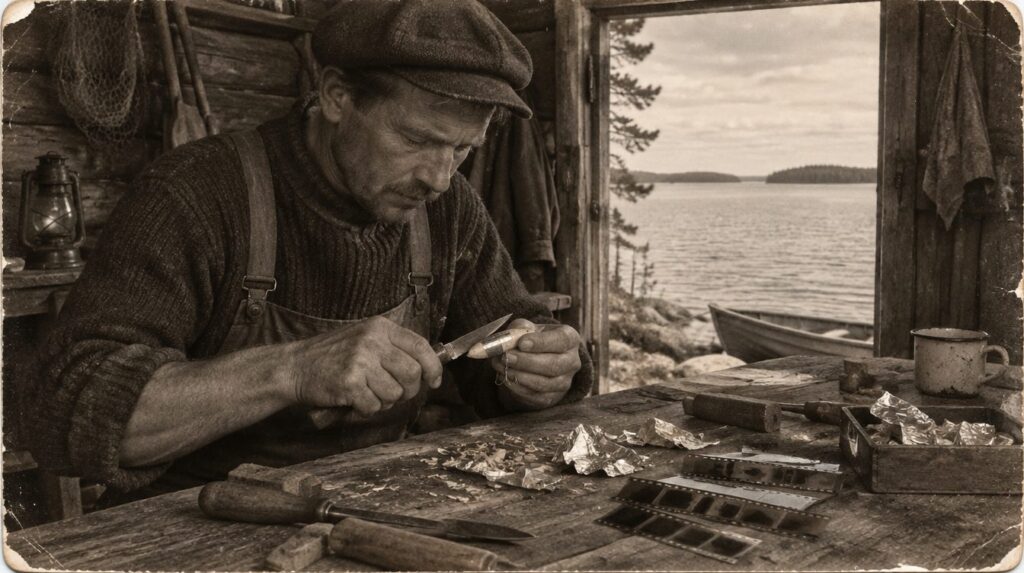
In 1936 Rapala carved an early working lure out of cork. The surface was finished with foil from a chocolate wrapper, and melted photo negatives were used as a protective coating. The combination sounds like the final of a modern upcycling contest. The real genius, however, was not the cheap shine but the movement: an unsteady, wobbling swim that imitated a small fish worth catching.
The reception: the fish voted first
Rapala’s own company history and the International Game Fish Association both describe how good catches made other people interested in the lures. Stories of huge daily hauls live on, but individual legendary numbers are best taken with a pinch of salt. In the fishing community the measure of success was less sophisticated than in today’s online shops: either a fish took the bait or it didn’t. The lure gained ground gradually, through hands-on experience.
The outcome: from local woodwork to the world
After the war years Rapala’s business grew stronger, and the lure became an international classic. Over the decades the brand expanded into many lure models and fishing gear. The original insight is still recognisable: an artificial small fish has to know how to swim just the right amount of wrong. The beauty of this invention is that you can understand how it works sitting in a boat, no engineering degree required.
Not just a fishing tale
What makes the history of lures interesting is the tension between handcraft and repeatable production. One successful lure carved at home doesn’t mean every following one will move the same way. Once Rapala’s lures started finding buyers, both shape and quality had to be controlled. Colours and materials also changed over the years. So the original chocolate-foil version is best seen as the start of product development, not as an exact blueprint of the modern product. In this innovation, a feel for the lake surface and practical experience were as important as the carving done at the workbench.
The Hilavitkutin reality check
Cork, chocolate foil and an old roll of film: three things you don’t usually build an international business on. The fourth essential ingredient was that the fish never read the product description.
Read more: Anatomy of a puukko: from tang to pommel – and what Finnish law says about carrying one and From cash register to vault guardian: how the Finnish Abloy lock was born. You can find every story in the series on our Finnish Oddities page.
Sources
- Rapala – company history (checked 1 Nov 2026)
- IGFA – the history of Lauri Rapala (checked 1 Nov 2026)