The Ball Chair: how Eero Aarnio put a space capsule in the living room

Finnish design
In the 1960s a Finnish designer looked at a chair and decided it didn’t have to look like a chair at all. The result was a fibreglass sphere you could sit in – and perhaps forget the rest of the world.
A chair or a little room of its own?
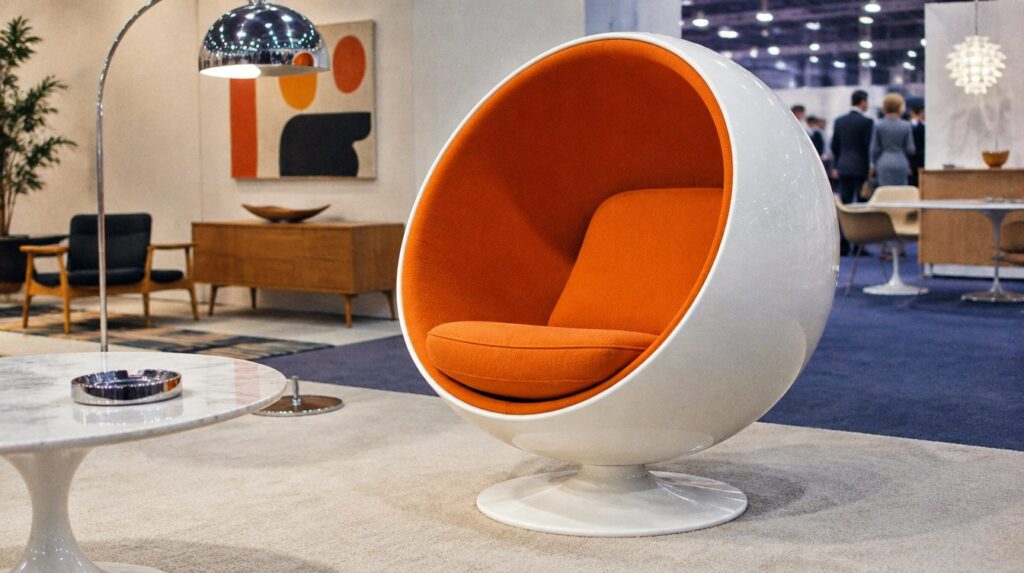
Designed by Eero Aarnio in 1963, the Ball Chair looks like something that could have landed in Helsinki harbour from another planet. Yet the idea came from an ordinary household need: Aarnio wanted to design a new kind of seat and became fascinated by the possibilities of plastics and fibreglass. The spherical shell wraps the sitter in a protective space – almost a little room of its own. At this point an ordinary Finn would probably have asked just one thing: how do you vacuum under it?
A prototype patched with newspaper
Aarnio has said he built an early mould with the help of his wife Pirkko and her brother Raimo. One early structure collapsed, so it was patched with newspaper and even toilet paper before fibreglass came into play. It is a wonderful reminder that a design classic can start out looking like a primary-school craft project. The materials engineering, however, was serious business.
Contemporaries: 30 countries interested in an instant
The Ball Chair was presented internationally at the Cologne Furniture Fair in 1966. According to Aarnio, chairs were sold to 30 countries during the week of the fair. That was the moment the futuristic object stopped being a curiosity of Finnish living rooms. The Ball Chair went on to become a favourite of pop and design imagery: it was used as a film and photo-shoot prop and ended up in museums. Colourful and large, it was anything but inconspicuous.
Where did the story lead?
The Ball Chair remains one of the best-known icons of Finnish design. Aarnio went on to create, for example, the Bubble Chair and the Pastil Chair. The Ball Chair’s story is not a rescue mission after a failure but an exceptional case in which a radical shape met commercial interest. The chair didn’t solve every problem in the living room, but it changed many people’s idea of what a piece of furniture is allowed to be.
Why didn’t it have four legs?
In the material experiments of the 1960s, plastic and fibreglass offered the chance to create shapes that traditional joinery couldn’t deliver in the same way. Aarnio’s spherical shell was also a visual statement: a piece of furniture can carve out its own space inside a room. Inside it, sound and your field of vision feel different from an ordinary sofa. It may look like a spaceship, but it doesn’t fly and needs no mission control. Moving the striking shape into production required proper manufacturing methods, so the idea was never just one artist’s amusing ball. It managed to combine a playful look, a working seat and an international brand.
The Hilavitkutin reality check
When you want some peace and quiet, you can go to your summer cottage or sit inside a ball. With the second option you don’t have to heat the sauna, but your guests may stare.
Read more: Fiskars’ orange-handled scissors: the accident that won a 9–7 vote and Mölkky: how a set of wooden pins became an international Finnish success story. You can find every story in the series on our Finnish Oddities page.
Sources
- Eero Aarnio – biography (checked 1 Nov 2026)
- Finnish Design Shop – interview with Eero Aarnio (checked 1 Nov 2026)
- V&A – Space-Age chairs (checked 1 Nov 2026)