The dish-drying cabinet: the invention of a Finn who decided to stop doing pointless work

Everyday solution developed in Finland
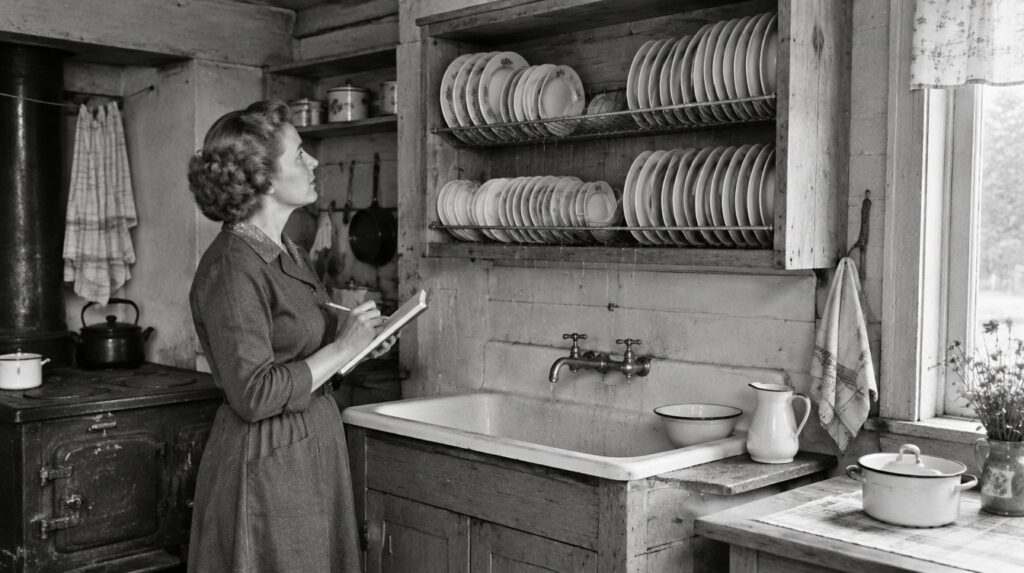
Maiju Gebhard didn’t build a rocket. She noticed that drying dishes by hand took up an unreasonable amount of time and moved the drying rack up onto the wall. Finnish kitchens were never the same again.
The kitchen’s invisible endurance sport
Washing up doesn’t end when the plate is clean. Before the drying cabinet became common, dishes were often dried with a tea towel and only then put away. For Maiju Gebhard of the Finnish work efficiency institute Työtehoseura, this was a recurring task worth questioning. In the institute’s calculations, the combined load of washing and drying dishes could add up to an enormous lifelong chore. The problem was an everyday one, so the solution didn’t have to come from outer space either.
An invention born on the wall
Gebhard’s development work began in 1944–1945, and the solution took inspiration from, among other things, a Swedish countertop drying rack. The insight was to combine drying and storage: clean dishes go onto racks inside a cabinet, where they drip and dry without separate towel-drying. The worktop is freed up and the tea towel finally gets a break. In Työtehoseura’s later description, the solution saved a considerable share of the time spent on the task, depending on how you count it.
Not quite the first in the world after all
In Finnish storytelling the drying cabinet is often called a Finnish invention, full stop. Here we need to be more precise: similar drying-cabinet designs were drawn up and patented in the United States and Germany as early as the 1920s and 1930s. Gebhard’s great achievement was developing a solution that worked and making it part of everyday life in Finnish kitchens. That takes nothing away from it; sometimes success means a good idea finally ends up in the right place.
How did the world react?
In Finland the drying cabinet became a standard kitchen fixture. Enso-Gutzeit started industrial production in 1948. Abroad the reception was much cooler: the idea didn’t spread nearly as widely as a Finn might assume. Why? Kitchen habits, furniture and building practices differ, and an excellent domestic solution doesn’t automatically transfer to another country. Still, the quiet approval of thousands of kitchens made it a home-grown success story.
What happened to it?
The drying cabinet is still a recognisable detail of the Finnish home. Its long life shows that the most durable innovations don’t always need complex electronics. Here, racks, air circulation and the wish to skip one unnecessary step were enough.
One small structure, one big change
The story also shows how household work has often been sidelined in tales of technical innovation. Industrialisation is happily described in terms of factories, tractors and engines, yet cutting hours of repetitive kitchen work is technological progress too. The drying cabinet spares its user lots of small movements – none of which seems significant until you multiply it by decades. Nor is it entirely maintenance-free: splashes, cleaning and air circulation all need attention. But compared with the number of parts involved, the benefit is exceptionally clear.
The Hilavitkutin reality check
Sometimes the best device of the day is the one that doesn’t beep, update or ask for a password. A drying cabinet only needs time, gravity and nobody sneaking a dirty coffee cup in there.
Read more: From cash register to vault guardian: how the Finnish Abloy lock was born and Mölkky: how a set of wooden pins became an international Finnish success story. You can find every story in the series on our Finnish Oddities page.
Sources
- Työtehoseura – the history of the dish-drying cabinet (in Finnish) (checked 1 Nov 2026)
- Yle Archives – Maiju Gebhard (in Finnish) (checked 1 Nov 2026)
- SVT – the drying cabinet as a Finnish everyday object (in Finnish) (checked 1 Nov 2026)