
Norway’s salmon-lice lasers – why they matter in Finland

Analysis
Norwegian firm Stingray Marine Solutions treats salmon lice in sea cages with a combination of cameras, artificial intelligence and a laser pulse. A figure of “over 2,000 robots and 50 million fish” has circulated on social media and in a technology blog, but the company’s own reports give higher numbers that also differ from one another. This matters in Finland because most salmon on sale here is farmed Atlantic salmon imported from Norway.
Key facts
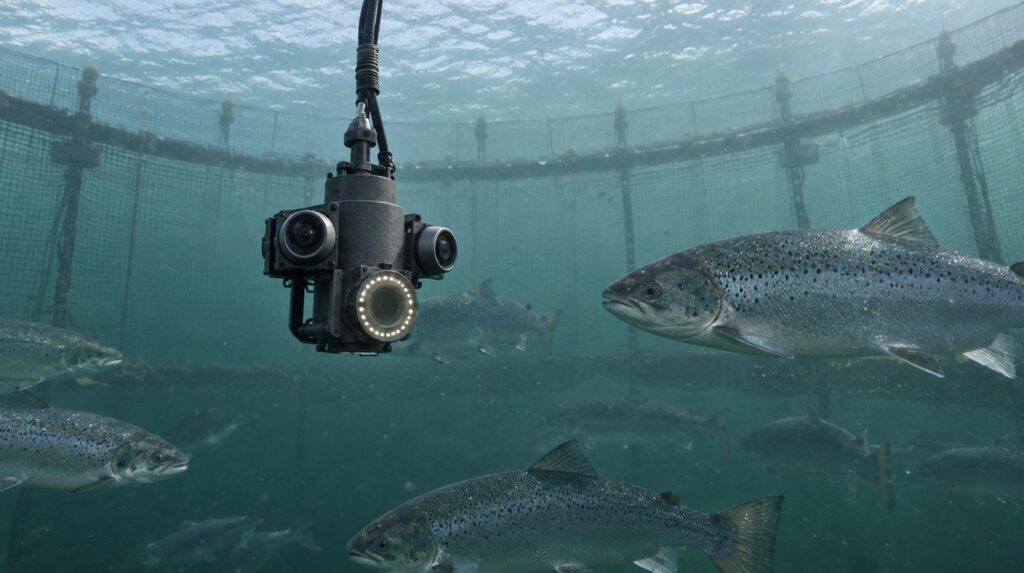
- The device is a unit lowered into a sea cage, not a free-swimming submarine. According to Stingray, it has stereo cameras, blue light (450 nm), AI software and a laser that can fire up to five pulses a second, around the clock. The unit can descend to about 20 metres (Sustainability Report 2025)
- The company’s Fish Health Report 2025 (dated 10 March 2026) says that at the end of 2025 the system was protecting 112,218,373 salmonids for 38 customers, with more than 2,500 units in operation in Norway and Iceland. The company says this covers 20–25% of farmed salmon in Norway. These are the company’s own figures
- The same company’s sustainability report (29 June 2026) shows about 3,000 active units for 2025. In August 2025 Stingray spoke of more than 2,000 units and more than 100 million fish
- Gadget Review repeats an outdated figure of “over 2,000 robots and more than 50 million fish”. Tom’s Hardware (11 November 2026) cites “over 3,500” units from “the most recent annual report”; no 2025 annual report with that figure was found on the company’s website
- Luke: in 2024 Finland imported 51 million kilos of fish and fish products from Norway (58% of all such imports). Whole fresh sea salmon accounted for 43 million kilos, of which 27 million kilos were re-exported
- Luke’s 2024 aquaculture statistics: Finland produced 16.6 million kilos of food fish, including 15.8 million kilos of rainbow trout. Three-quarters grew in marine net pens
How the laser unit works
The machines are not free-swimming submarines, even if they are often called robots. They are units lowered into a sea cage. According to the company, fish swim past the cameras, blue light makes the louse stand out from the skin, software identifies the parasite and a laser pulse hits it while the fish swims freely. The unit can fire up to five pulses a second and runs around the clock. The company says it can descend to about 20 metres and be rotated remotely. The fish do not have to be crowded or pumped, unlike in thermal or mechanical delousing.
Does it work better than conventional delousing?
Non-medicinal delousing is a serious welfare problem in Norway. In the survey published in the Norwegian Veterinary Institute’s Fish Health Report 2024, injuries from non-medicinal treatments were the leading cause of mortality on grow-out farms. Walde and colleagues (2021) found that the extra mortality after thermal and mechanical treatments was, for the 2017 year-class, 5.4 and 6.3 times higher than after medicinal treatment.
Independent evidence on the laser’s effect is mixed. In the same survey, 75 respondents had experience with lasers, but 56% could not judge how well they worked. Respondents found lasers useful when lice numbers were low; under high lice pressure the effect was hard to see. Results varied with current, the number of units and how they were positioned. In a commercial trial in winter 2018–2019, the Institute of Marine Research found no reduction in lice in snorkel cages with lasers compared with control cages (Bui et al., 2020). The company itself reports fewer treatments at its own sites; that is the company’s own data.
A secondary blog post has claimed that the 2024 fish-health report links lasers to severe unilateral cataracts in harvest-size salmon. The report does not reach that conclusion. Two respondents described gas bubbles in the eyes of otherwise healthy fish and mentioned the lice laser as a possible cause; others reported the same finding in pens where no laser was used.
What this means for salmon in Finland
Salmon lice are not the same problem in Finland as they are in Norwegian Atlantic-salmon pens. The salinity of the Baltic Sea averages about 7 per mille, a fifth of typical ocean salinity. The salmon louse is a marine parasite that needs clearly saltier water to reproduce. Units of this kind are not known in Finnish marine aquaculture, and there is no comparable need for them here. Finnish shoppers still mainly eat farmed Norwegian salmon, so Norway’s lice control is part of the story of the fish that ends up on the counter.
Sources
- Stingray: technology page (camera, blue light, laser) (read 12 Nov 2026)
- Stingray, Fish Health Report 2025 (10 Mar 2026): units and 112,218,373 salmonids (read 12 Nov 2026)
- Stingray, Sustainability Report 2025 (29 Jun 2026): about 3,000 active nodes (read 12 Nov 2026)
- Stingray / iLaks (4 Aug 2025): more than 2,000 units and over 100 million fish (read 12 Nov 2026)
- Gadget Review: “over 2,000 robots and 50 million fish” (read 12 Nov 2026) (read 12 Nov 2026)
- Tom’s Hardware (11 Nov 2026): cites “over 3,500” units from an annual report (read 12 Nov 2026)
- Norwegian Veterinary Institute: Fish Health Report 2024 (read 12 Nov 2026)
- Walde, Jensen, Pettersen and Stormoen (2021), Journal of Fish Diseases (read 12 Nov 2026)
- Institute of Marine Research (25 Jun 2020): no laser effect in snorkel cages (read 12 Nov 2026)
- Bui, Geitung, Oppedal and Barrett (2020), Preventive Veterinary Medicine (read 12 Nov 2026)
- Luke: Foreign trade in fish 2024 (published 4 Sep 2025) (read 12 Nov 2026)
- Luke: Aquaculture 2024 (published 27 Jun 2025) (read 12 Nov 2026)
- Itämeri.fi: Baltic Sea in figures (salinity about 7 ‰) (read 12 Nov 2026)