Ring Drone Cam – a US indoor drone, not on sale in Finland yet

Analysis
Amazon-owned Ring unveiled two new devices on 10 November 2026: the Ring Drone Cam, a flying indoor camera for the home, and the Ring Rover Cam, a patrolling robot for businesses. According to Amazon’s announcement, they will launch in the United States first. For a buyer in Finland the useful questions remain: may such a drone fly in a block of flats, and where does the footage go?
Key facts
- The Ring Drone Cam costs $249.99, about €223 at the ECB rate on 10 November 2026 (€1 = $1.1214). US shipments start on 27 January 2027, if the FCC authorises the device in time (Amazon, Ring)
- The Ring Rover Cam costs $999.99, about €892 at the same rate. It is on pre-order in the United States, with shipments from 16 December 2026 (Amazon, Ring)
- The drone records 2K video (1,920 × 1,920), has a 148° field of view and flies for up to eight minutes in lab conditions. It records only while flying and has no microphone or siren. The operating temperature is 5–35 °C, indoor use only (Ring)
- The Rover records in up to 4K and has a periscope camera, a siren and two-way audio. It is for a single floor and covers up to about 465 m² (Ring)
- Scheduled flights and reviewing recordings require a Ring Protect plan. In the US the Solo plan is $4.99 a month or $49.99 a year. No EU sale has been announced (Amazon, Ring)
What the Ring Drone Cam is for
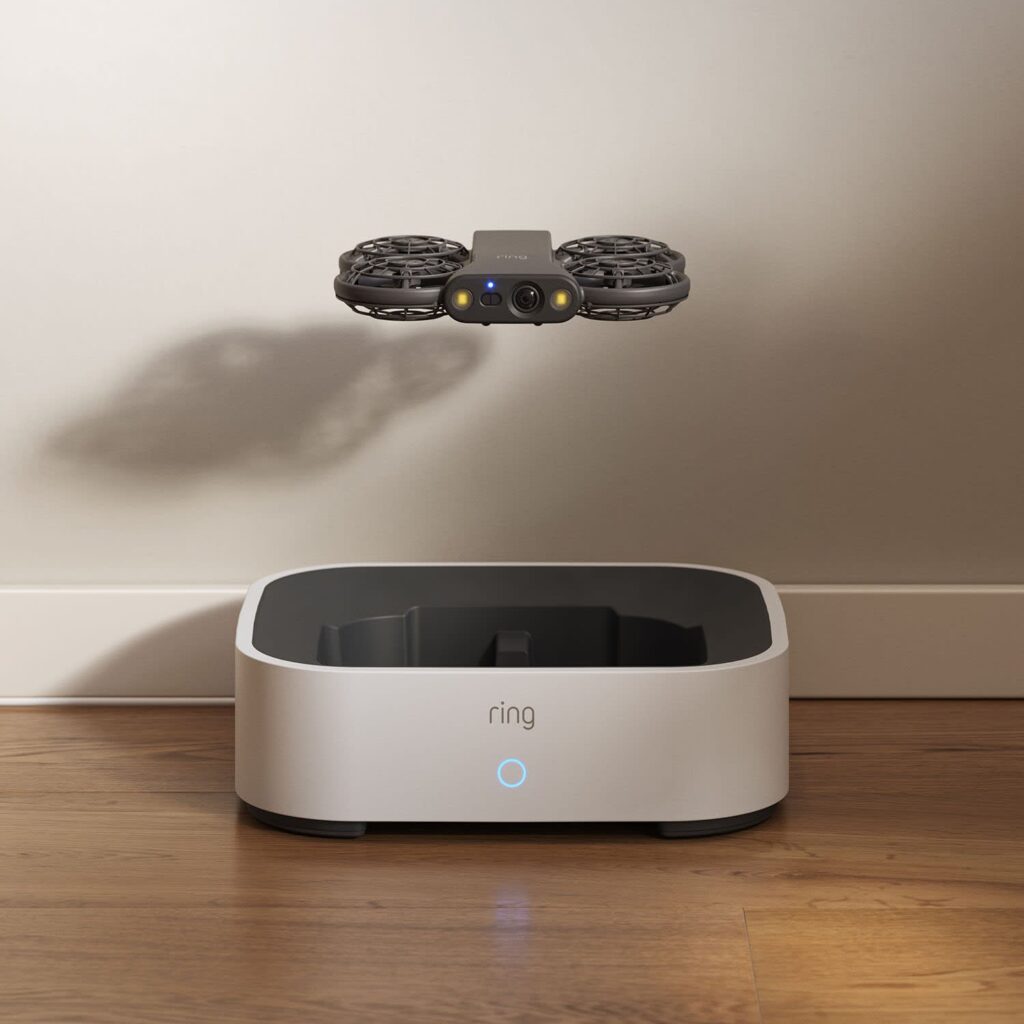
According to Ring, the Drone Cam is a flying indoor camera meant to show the whole home with a single device, without mounting a camera in every room. It waits out of sight in its dock, and the camera is off when it is not flying. Amazon’s announcement says you can send it out yourself, schedule a route, or let it take off when a Ring camera, sensor or alarm is triggered. Scheduled flights require a Ring Protect plan, Ring’s product page confirms.
A typical use is checking the home when you are not there. In Amazon’s examples, you can send the drone on a final sweep to confirm the windows are shut before a weekend trip, or see what set off an alert while you are at work or on vacation. It works with Ring cameras, doorbells, sensors and alarms out of the box. CEO Jamie Siminoff also described it to CNBC as a crime deterrent: the lights make the device noticeable, and Amazon says the propellers are not quiet.
The advantage over a fixed camera is that it can move, but there are trade-offs. Ring promises up to eight minutes of flight in lab conditions, and The Verge reports that Ring says each minute in the air needs about eight minutes of charging. The Verge suggests the device is better suited to quick check-ins than continuous monitoring, and it is still unclear whether it can replace several fixed cameras. The price is $249.99, and scheduled flights and reviewing recordings require a paid Protect plan. Recording stops in the dock, but the video still goes through Ring’s cloud.
What the Ring Drone Cam and Rover Cam do
Both are driven by Ring’s AI Pilot: the device builds a floor plan, suggests patrol points and steers around obstacles on its own. The system uses cameras, on-device sensors and cloud processing. You can send the drone out yourself, schedule a route, or have it take off when another Ring device is triggered. In the dock the camera is off. The Rover is aimed at businesses: it scans a room in a full circle, raises a camera over a counter and can sound a siren. Ring says it drew on Amazon’s Astro robot, but built the Rover for security.
The idea is not new. In 2020 Ring showed an indoor drone called the Always Home Cam at the same $249.99 price, but it never went on general sale, GeekWire reports. We have not tested the new devices.
Price and availability in Finland
Amazon and Ring are launching in the United States only. For now the Drone Cam is an email waiting list, because FCC authorisation is still pending. The Rover Cam can be pre-ordered, but it does not ship to Canada. The euro figures are a conversion, not a Finnish shelf price. The Verge confirms that the Drone Cam will at first be sold only in the US. Ring doorbells and fixed cameras have been sold in Finland before, but these robotics devices have not been announced for the EU market. The manufacturer has not announced CE marking or a European warranty. The Drone Cam’s 5–35 °C range (the Rover Cam’s is 0–35 °C) is fine in a normal flat, but a cold porch or a winter cottage may fall below the Drone Cam’s limit. Until the drone is sold in the EU, a practical option is a fixed camera that records to a memory card with no monthly fee – we have already looked at the Eufy Window Camera E10, for example.
What Traficom and privacy law say
Staying indoors eases the aviation rules. The EU product regulation for drones, Regulation (EU) 2019/945, does not apply to drones intended exclusively for indoor use. EASA’s guidance on Implementing Regulation (EU) 2019/947 says that “operation of unmanned aircraft systems” under that regulation does not include indoor flights in a house, a building, or another closed space where the aircraft is very unlikely to escape into outside airspace. If the device flies outside, the open-category rules and operator registration may apply. Ring forbids outdoor use, and Jamie Siminoff told CNBC that the drone has safeguards to stop it flying out.
Filming is still tightly regulated. According to the Office of the Data Protection Ombudsman, the household exemption can cover camera use by a private person only when the filming is purely personal and the picture does not extend even partly into the street or a neighbour’s property. A flying camera can easily see a bedroom, a neighbour’s window or a stairwell. Traficom notes that people in places protected by domestic or public peace may not be filmed in an identifiable way; this is set out in Chapter 24 of the Criminal Code. Traficom also points out that storing personal data in a cloud service can amount to disclosing it if the provider can access the material. Ring’s AI Pilot uses cloud processing, and according to The Verge and Ars Technica the TAKE encryption is not full end-to-end encryption. This is not legal advice; check the current guidance from Traficom and the ombudsman.
Sources
- Amazon (10 Nov 2026): Ring Robotics announcement (accessed 11 Nov 2026)
- Ring: Drone Cam product page (accessed 11 Nov 2026)
- Ring: Rover Cam product page (accessed 11 Nov 2026)
- NBC News (10 Nov 2026): Ring’s drone and robot (accessed 11 Nov 2026)
- CNBC (10 Nov 2026): flight time and outdoor ban (accessed 11 Nov 2026)
- GeekWire (10 Nov 2026): Always Home Cam and Astro (accessed 11 Nov 2026)
- The Verge (10 Nov 2026): Drone Cam hands-on (accessed 11 Nov 2026)
- Ars Technica (10 Nov 2026): privacy and TAKE encryption (accessed 11 Nov 2026)
- Traficom: privacy and data protection (accessed 11 Nov 2026)
- Traficom, regulation OPS M1-32 (2021) (accessed 11 Nov 2026)
- EASA: GM1 Article 1 to Regulation (EU) 2019/947 (indoor operations) (accessed 11 Nov 2026)
- EUR-Lex: Regulation (EU) 2019/945 (accessed 11 Nov 2026)
- Data Protection Ombudsman: home camera surveillance (accessed 11 Nov 2026)
- Ring: Protect plans (United States) (accessed 11 Nov 2026)
- ECB: EUR/USD reference rate, 10 Nov 2026 (1.1214) (accessed 11 Nov 2026)