From cash register to vault guardian: how the Finnish Abloy lock was born

Finnish invention
An office-machine mechanic in Helsinki looked at the rotating discs inside a cash register and saw something nobody else had: a new way to lock a door. His 1907 idea became one of the most enduring success stories in Finnish industry.
A problem that didn’t need reinventing
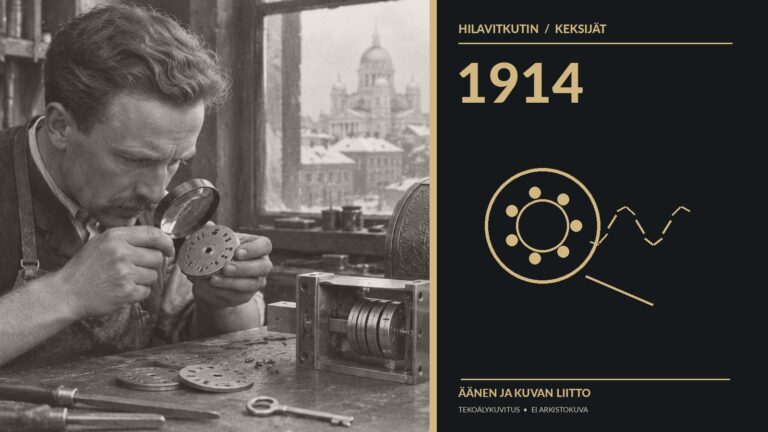
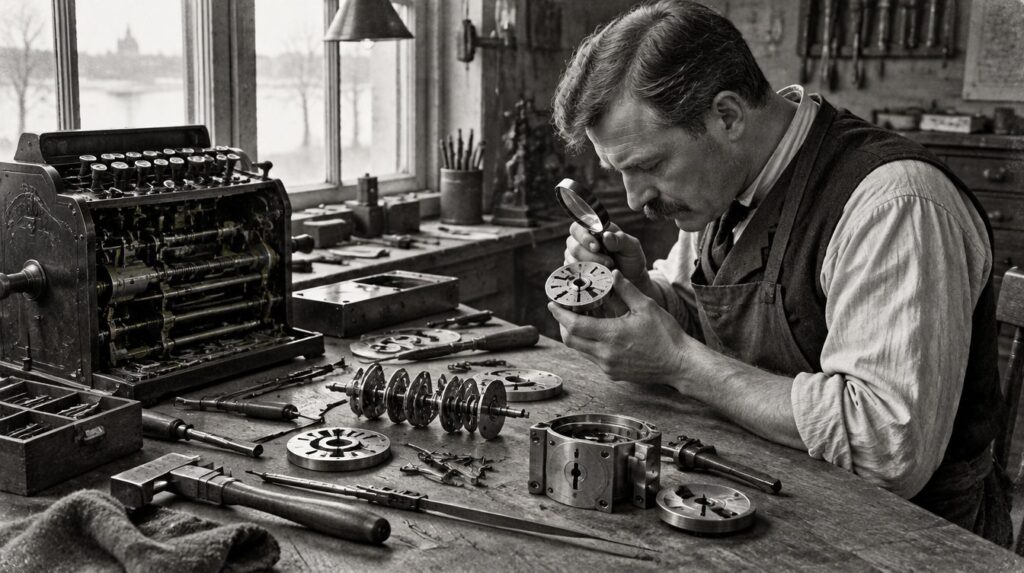
Locks had been around for centuries before 1907. Emil Henriksson’s idea was not to be the first person in the world to lock a door, but to make a lock work on a new principle. He noticed how the rotating discs in a cash register lined up and realised that a similar mechanism could be used to make a key and a lock work together. Where many locks rely on moving pins, in a disc lock the key turns a set of discs into the correct positions. Once every part is lined up, the lock lets the mechanism move.
The reaction at the time: first the workshop, then production
Plenty of invention stories feature a world that bursts into applause at the very first demonstration. There is no need to make up a scene like that here. Abloy’s early success shows up in more concrete ways: a patent for the principle was applied for in 1918 and granted in February 1919, and industrial production began in Helsinki. In 1920 the product got the ABLOY name. Its reception is told better by decades of use than by any single headline. After all, a lock has to convince its user every single day, not just at an invention fair.
What was so odd about it?
A cash register is meant for counting, a lock for closing. Yet the same mechanical ideas can travel surprisingly far from their original purpose. The most charming part of Henriksson’s insight is the engineer’s way of looking at an everyday machine: he didn’t just see money, he saw discs whose order mattered. In today’s language, he pulled off a successful technology transfer without a single PowerPoint slide.
What happened to the invention?
Abloy grew into a major Finnish lock manufacturer and merged with Sweden’s Assa in 1994 to form the ASSA ABLOY group. The disc principle still lives on in locking solutions, even though digital access control has joined it. One important caveat: no lock is literally impossible to break. Abloy’s significance lies in a reliable, precisely manufactured mechanism and its long history of further development.
Why it didn’t stay a one-off curiosity
The disc lock’s properties made it possible to build many different key and lock solutions. That mattered: a single working prototype can be impressive, but a locking system also has to work in schools, apartment buildings, factories and key management. In lock making, tight tolerances, key control and serviceability are at least as important as a clever principle. Henriksson’s idea gave later engineers a platform to build on. When a locksmith looks at a new device, they probably don’t ask whether it is cute – they ask how it will cope with being locked and unlocked thousands of times a year.
The Hilavitkutin reality check
If the idea for a new lock comes from studying a cash register, maybe the next thing to look at is what goes on inside a coffee maker. Just don’t start taking it apart while it’s plugged in.
Read more: Fiskars’ orange-handled scissors: the accident that won a 9–7 vote and From sauna stove to world market: what Finnish sauna technology actually invented. You can find every story in the series on our Finnish Oddities page.
Sources
- ABLOY – history (checked 1 Nov 2026)
- University of Helsinki – Emil Henriksson, inventor of the Abloy lock and mechanic at the chemistry department (in Finnish) (checked 1 Nov 2026)