Robots assemble Thule roof racks – why is Finland behind Sweden?

Analysis
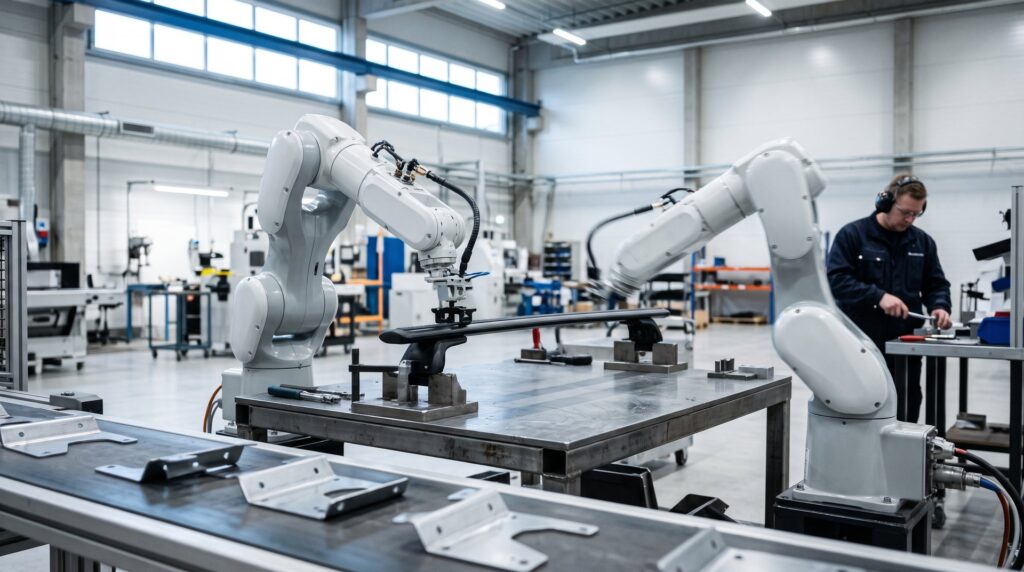
Swedish company Thule has replaced about 80 workers with 80 robots at its Hillerstorp factory over ten years, and output has grown at the same time (Tekniikka&Talous, Ny Teknik). If there is a Thule roof rack on your car, its parts may well have passed through a robot line. We looked at what the robots do at the factory, what they cannot do, and why Finland has half as many robots as Sweden.
Key facts
- Hillerstorp makes roof racks and metal parts for other Thule products. Of the site’s roughly 550 employees, 270 work in product development and testing (T&T).
- The assembly lines have around 80 robotic stations that assemble roof racks, crossbars and fit kits (Bikerumor).
- In 2024 Sweden had 377 and Finland 183 industrial robots per 10,000 manufacturing employees (IFR, Visual Capitalist).
What do the robots do for a roof rack?
It starts with sheet metal. Hillerstorp has 16 large stamping presses, and the parts move on to mostly automated assembly lines (Bikerumor). According to site manager Kristian Fältengård, the presses turned out as many as 55 million parts in a single year (GnosjoRegion). Hundreds of thousands of roof racks are made every year, and the new lines installed in 2018–2021 cost about SEK 100 million (Aktuell Produktion).
People have not been removed entirely. The lines were designed so that workers sit at the stations where products are most likely to change. In 2021, picking fit-kit parts into boxes was still done by hand, because the company called it the hardest step in the whole chain (Aktuell Produktion). According to Bikerumor, there are about 1,700 foot variants so that the rack fits nearly every car.
Why is the bike carrier made elsewhere?
Robots cannot do everything. According to Fältengård, more complex products such as bike carriers and strollers cannot be automated in the same way, so they are made in countries with cheaper labour (T&T). For roof racks the maths is different: product development director Karl-Johan Magnusson says keeping production next to R&D gives better control and faster reactions.
Finland has half as many robots as Sweden
According to the IFR, Sweden is the fifth most automated country in the world, while the EU average is 231 (IFR). Finland ranked 19th in the same comparison (Visual Capitalist). In the newer World Robotics 2026 report, Sweden’s figure has been reported as 392 (Robotics Reviewed). We could not find Finland’s 2025 figure in public sources.
According to a review by Finnish trade magazine Automaatioväylä, the gap is partly structural: globally the biggest robot buyers are the electronics and car industries, which Finland has little of. Finnish engineering workshops, by contrast, automate a lot by international standards (Automaatioväylä).
Hilavitkutin’s take: Thule’s story is not about robots taking every job. It shows that repetitive sheet-metal work gets automated while complex assembly stays with people – just in different countries.
Sources
- Tekniikka&Talous (in Finnish): Swedish company swapped 80 workers for 80 robots (26 Nov 2026, first published Oct 2026) (accessed 26 Nov 2026)
- Ny Teknik (in Swedish): Takräckesfabriken bytte 80 anställda mot 80 robotar (21 Oct 2026) (accessed 26 Nov 2026)
- Bikerumor: Behind the scenes at Thule’s Hillerstorp test center (26 Jan 2026) (accessed 26 Nov 2026)
- Aktuell Produktion (in Swedish): Utvecklingsmöjligheter med flexibel automation (31 May 2021) (accessed 26 Nov 2026)
- GnosjoRegion (in Swedish): Lokal produktion i hjärtat av Thule (16 Feb 2023) (accessed 26 Nov 2026)
- IFR: Robot Density Surges in Europe, Asia, and Americas (World Robotics 2025) (accessed 26 Nov 2026)
- Visual Capitalist: Countries With the Most Industrial Robots per Worker (6 Oct 2026, IFR data) (accessed 26 Nov 2026)
- Robotics Reviewed: Robot Density Statistics 2026 (11 Nov 2026) (accessed 26 Nov 2026)
- Automaatioväylä (in Finnish): Robotics statistics 2023 (PDF) (accessed 26 Nov 2026)