
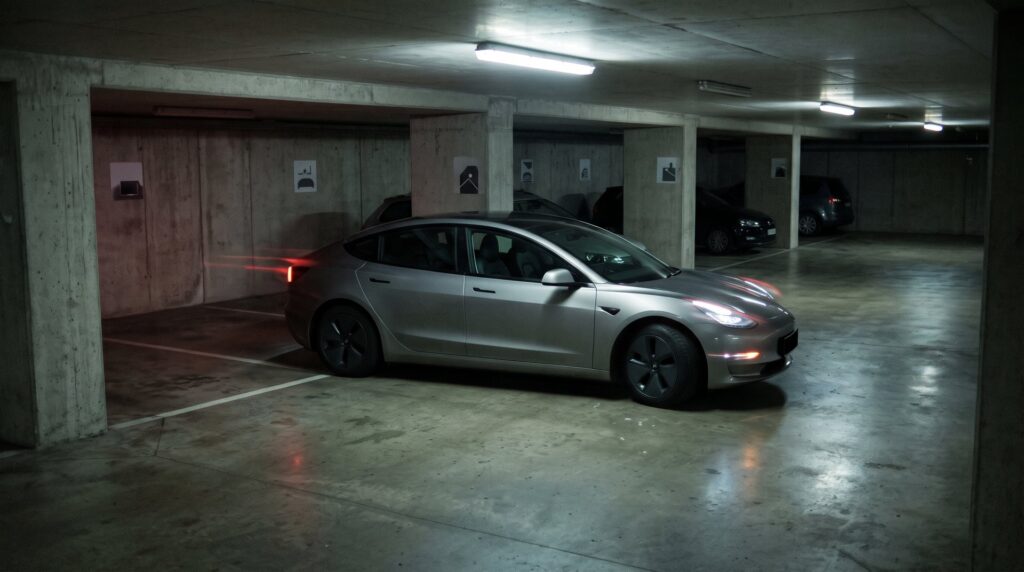
Car parks itself 868 times – how remote parking works in the EU

Analysis
A Chinese electric car tried to park itself 868 times overnight in an empty parking garage (Maeil Business Newspaper, Iltalehti). The video is funny, but it raises a question: could remote parking run wild like that in Finland? The short answer is that EU rules make it very difficult.
Key facts
- It happened in an underground garage of an apartment block in Anhui province. According to logs checked by the owner, the parking function was activated 868 times overnight (MK, NDTV).
- The car has been reported as an Avatr 12 with Huawei’s Qiankun driver-assistance system. According to Gadget Review, the model has not been officially confirmed (Gadget Review).
- In the EU, the remote parking range may not exceed 6 metres, and the driver must keep the remote device continuously activated (UN Regulation No 79).
What happened in the garage?
In the CCTV footage the car drives into a bay, backs out and tries again. A security guard went to check the noise, but nobody was in the driver’s seat (MK). According to CarNewsChina, similar videos of several Avatr and Huajing models using Huawei technology spread in November. In one of them, an Avatr 06 and an Avatr 12 park side by side in sync at around 6 am (CarNewsChina).
In the background was a Huawei contest held from 31 October to 13 November 2026. More than 190,000 drivers signed up, and one category rewarded the number of successful uses of parking assistance. However, points were only awarded between 6 am and 10 pm, so the overnight attempts benefited nobody (CarNewsChina, Motorpasión).
The cause has not been confirmed. Three explanations have been put forward: the owner repeatedly triggered the function from the app, dim lighting or faded bay markings interrupted the manoeuvre, or there was a software fault (CarNewsChina). Huawei had not responded to requests for comment (Gadget Review).
Could the same happen in Finland?
In the EU, remote parking is governed by UN Regulation No 79. The driver must start the function, speed is limited to about 10 km/h, and the remote device, such as a phone, must be actuated throughout the manoeuvre. The car must stop immediately if actuation stops, the signal is lost or the distance exceeds the operating range, which may be no more than 6 metres (EUR-Lex). A car whose owner is asleep should therefore not be circling the garage alone.
The limit may be relaxed, though. Carmaker and supplier associations OICA and CLEPA proposed in 2026 raising the range to 15 metres. They say radio-based distance measurement is so imprecise that the usable range often shrinks to 2–3 metres. According to the associations, the range is not regulated in China, the US or Canada (UNECE).
Fully driverless parking is allowed in Europe only in specially approved garages. In 2022 Germany’s motor transport authority KBA approved a Mercedes-Benz system in which the garage’s own infrastructure guides the car to a reserved bay (KBA).
Is Avatr coming to Finland?
Not yet, at least. In October in Paris, Avatr announced it would enter Europe in 2027. According to NordiskBil, the first markets are Norway and Spain, while a press release from Avatr’s Norwegian importer also mentions the UK (NordiskBil, Avatr Norge). Finland has not been mentioned. Judging by Google search suggestions, Finns are currently looking up remote parking mostly for Kia, Hyundai and Skoda cars.
Hilavitkutin’s take: China’s “ghost cars” show what happens when parking assistance becomes a points contest. In Europe, a human finger stays on the button for now.
Sources
- Iltalehti (in Finnish): Electric car went haywire overnight (27 Nov 2026) (accessed 27 Nov 2026)
- CarNewsChina: China’s “ghost EVs” – why empty Huawei-powered cars are roaming parking garages at night (19 Nov 2026) (accessed 27 Nov 2026)
- NDTV: China’s “Ghost EV” tries to park itself 800 times overnight (Nov 2026) (accessed 27 Nov 2026)
- Maeil Business Newspaper: A ghost in a Chinese EV? 868 parking attempts overnight (24 Nov 2026) (accessed 27 Nov 2026)
- ZhongAuto / Motorpasión: AVATR 12 logged 868 automated parking activations overnight in Anhui (23 Nov 2026) (accessed 27 Nov 2026)
- Gadget Review: A Chinese EV spent the night trying to park itself 868 times (Nov 2026) (accessed 27 Nov 2026)
- EUR-Lex: UN Regulation No 79 (steering equipment, incl. Remote Controlled Parking), EU 2025/3 (accessed 27 Nov 2026)
- UNECE GRVA-25-13: OICA–CLEPA proposal on the maximum RCP operating range (2026, PDF) (accessed 27 Nov 2026)
- Kraftfahrt-Bundesamt (in German): First approval for a driverless parking vehicle (30 Nov 2022) (accessed 27 Nov 2026)
- NordiskBil: Avatr debuts in Europe, starting from Norway in 2027 (Oct 2026) (accessed 27 Nov 2026)
- Avatr Norge (in Norwegian): AVATR går inn i det europeiske markedet (11 Oct 2026) (accessed 27 Nov 2026)