What useful things can you make with a 3D printer? 15 ideas that genuinely make everyday life easier

Guide
Not just plastic dragons: a 3D printer shines when no shop sells a part in exactly the right size.
3D printing at home – part 2/5
From plastic clutter to solving everyday annoyances
Most people first see a 3D printer making a tiny boat or a figure with a suspiciously large head. There is nothing wrong with that. But a printer’s best side often only shows when some small, annoying thing at home breaks: a drawer slide, a lamp holder or the plastic cover of an old appliance. When the right part is not available in shops, you can sometimes design it yourself and print it.
The word “sometimes” matters. Not every spare part can be replaced with printed plastic. Parts exposed to heat, electrical loads, heavy mechanical stress, safety functions or food should not be made without properly verifying the material and design. Printing is best suited to low-risk objects that are easy to inspect.
1–5: Rescuing your desk from cable chaos
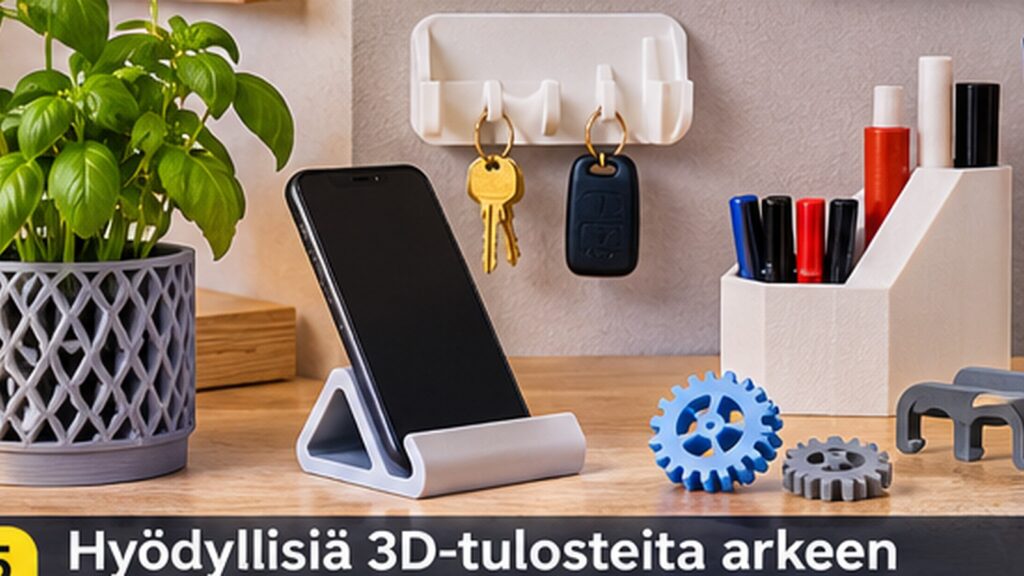
- Phone stand. Measure the thickness of the phone and any case, choose a suitable viewing angle and print a simple desk stand. PLA is enough for most indoor uses.
- Headphone hook. A hook that fits under the edge of the desk frees up space. Measure the mounting surface carefully and do not drill into furniture unless you have to.
- Cable clips. A three-millimetre difference in hole size can decide whether the charging cable stays put or drops behind the desk.
- Memory card and USB organiser. A small organiser ends the daily desk lottery: where did that adapter go this time?
- Tool holder. Slots for screwdrivers and hex keys can be sized exactly for your own set. The desk manufacturer no longer gets to decide how many screwdrivers you own.
6–10: Home, kitchen and garden
- Drawer dividers. A modular design lets you combine parts without having to print the whole insert in one piece.
- Wall holder for the remote. Useful especially at a holiday cabin, where the remote regularly disappears under the sofa blankets.
- Plant pot cover or saucer. Note that a layered print can seep, so protect surfaces from water and test for leaks.
- Plant labels. Good for herb beds and growing seedlings. Outdoors, choose a material that withstands the weather better than PLA.
- Measuring spoon hanger or cupboard door organiser. Only print parts that do not come into contact with food, unless their safety for that use has been verified separately.
11–15: Repairs, hobbies and the cabin
- Vacuum cleaner nozzle adapter. If two hoses do not fit together, a measured spacer ring can save an otherwise working appliance; avoid parts exposed to hot exhaust air.
- Missing board game piece. A home printer is almost perfect for this: the right size, the right shape and the right colour.
- Painting or gluing aid. A small painting stand, for example, keeps the part you are working on off the table. Check chemical compatibility.
- Drill depth stop holder or saw guide template. A print can help with marking and alignment, but it does not replace a safety device approved for the purpose.
- Camera desk support or cable clamp. Only for light gear and situations where a fall would not be dangerous. A printed tripod for an expensive camera can be an unnecessarily optimistic invention.
How do you find a model and adapt it?
Start with a ready-made STL or 3MF model. Libraries such as Printables, MakerWorld and Thingiverse offer thousands of ideas. Read the model’s licence, user comments and print settings. Do not rely on a flashy render alone: a model with thin sections and lots of overhangs may need supports and some fitting.
A slicer turns the model into layers and instructions for the printer. Choose the correct profile for your printer, start with a calm default quality and, if needed, print a small test piece before the whole object. If you design your own, a browser-based tool like Tinkercad gets you a long way without an engineering degree.
The most important measuring tool is a calliper. A printer’s nominal accuracy does not automatically produce a correctly sized spare part: tolerances, shrinkage and nozzle width all play a part. Measure, print, test, adjust. That is the core of the whole hobby.
How much does one useful print cost?
If a spool of filament costs, say, €22 per kilo, the plastic for a 40-gram phone stand costs about €0.88. On top of that come electricity, any support material, failed attempts and your own time. A big machine does not make free products by itself, but a small plastic part can be exactly the solution you could not buy anywhere.
Hilavitkutin’s reality check: your first printed object is usually useless. The third is already better. By the fifth, someone asks whether you could make one for them too. At that point the printer may have found its true purpose.