Two water pumps sent each other 2.2 million text messages – how to avoid the same as the 2G network ends

News
Background: This story is based on reports in Swedish media (DN, SVT, Aftonbladet, TT) and on information published by the Finnish regulator Traficom and Finnish operators. We have not tested the devices mentioned.
Imagine opening your post and finding a bill for 1.4 million Swedish kronor – followed by a moving box full of itemised records. That is what happened in Mariefred, Sweden, where two water pumps sent each other about 2.2 million text messages in a single month. It is a funny story, but it is also a warning for anyone with a GSM controller at the summer cottage, in the garage or on the heat pump. The 2G network is ending in Finland too, and the moment you swap devices is exactly when things go wrong.
Key facts
- Where: Slottsbrinkens sjövattenförening, Mariefred, Sweden – an association of about a hundred homes that pumps lake water from Mälaren for irrigation
- What: two pump controllers sent each other roughly one text message per second for about a month
- Messages: about 2.2 million (DN, Feber); SVT reports about 2 million and Aftonbladet 1.8 million
- Bill: SEK 1.4 million, well over €100,000, with about 32,000 pages of itemisation
- Why: the “free texts” plan had a 15,000-message monthly cap in the small print
- Outcome: the operator Telenor cancelled the bill after negotiations
- In Finland: operators’ obligation to maintain 2G networks ends at the end of 2029
What happened in Mariefred?
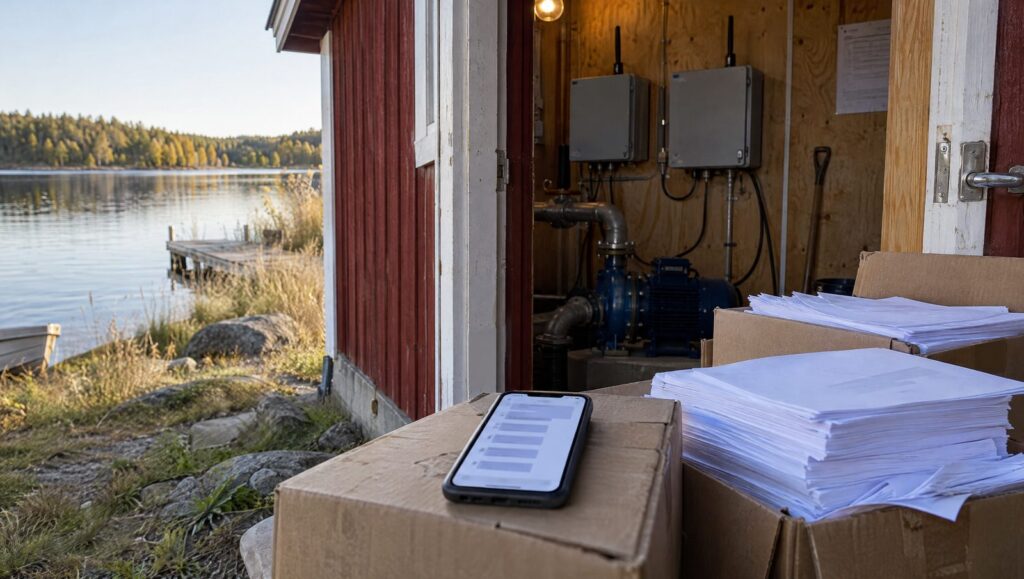
Since the 1970s the Slottsbrinken area has had a system in which two pump houses lift lake water from Mälaren to households for irrigation. The pumps were controlled over the 2G and 3G networks. With network shutdowns looming, the association bought a new control system and tested it for about a month from mid-May with a new operator. It never worked properly, so the association went back to the old one.
At the end of the summer the bill arrived. Association chair Ludvig af Klinteberg told DN that the control units had been sending each other a message every second. Translated from machine code, the content was roughly “I’m out of water here, can you take over?” Normally about ten messages a day pass between them.
The plan came with “free texts”, but the terms set a limit of 15,000 messages. Every message above that cost 63 öre (65 öre according to Aftonbladet) plus VAT. When the association asked for a traffic statement, it received about 32,000 pages of paper in boxes. The Swedish site Feber, which broke the story, suggested a SIM card bug that trapped the units in an endless loop. The exact cause is unknown: the fault could lie in the hardware, the software or the installation settings.
The chair admitted that the operator was technically in the right, but the bill felt unreasonable because nothing flagged the abnormal traffic. In the end Telenor cancelled it. The association bought prepaid SIMs for the pumps and returned to the old 2G control – according to DN, Sweden’s 2G network will keep running for about another year.
Why do devices send text messages at all?
A text message is an old, simple way to send commands, and it works almost everywhere. That is why it is popular in so-called M2M (machine-to-machine) communication. In Finland, text messages commonly control things such as:
- GSM controllers for air-source heat pumps at cottages and homes
- GSM controllers for car or boat auxiliary heaters
- remote control of cottage heating and electricity
- alarm and surveillance systems in buildings
- trail cameras, trackers and gate automation
- pumping stations, wells and other measuring and control devices
The trouble starts when two automated devices talk to each other with no human in between. If device A acknowledges every message and device B acknowledges the acknowledgement, you get a loop that never gets tired. A human only notices it on the bill.
2G is ending in Finland too – when?
According to Traficom, Finnish operators’ obligation to maintain 2G (GSM) networks ends at the end of 2029, after which the networks may be closed. An operator must notify Traficom at least a year before a shutdown. Elisa and DNA say their 2G networks will run at least until the end of 2029 and that no exact date has been set. Telia has not made a final decision. On Åland, Ålcom already closed its 2G network on 3 February 2025.
Mainland Finland’s 3G networks are already gone: Elisa closed its network in November 2023, and DNA, Telia and their joint company Suomen Yhteisverkko did so in 2023–2024. Many older devices then quietly fell back to 2G – which puts them next in line. Once 2G is switched off, a 2G-only device can no longer make calls, send texts or transfer data, even if it otherwise works perfectly.
How to check your GSM controller and cottage devices
- List every device with a SIM card. Heat pump, auxiliary heater, alarm, trail camera, tracker, gate – including ones someone else installed.
- Find out which network each device uses. If the manual or the rating plate only says GSM or 2G, or only 2G and 3G (Finland’s 3G networks are already shut down), the device must be replaced before the shutdown. Look for 4G, LTE, LTE-M or NB-IoT.
- Insist on 4G or 5G support when buying. According to Traficom, the seller is liable for a defect if it does not tell you that the 2G shutdown will shorten the device’s normal lifespan.
- Read the small print of the plan. “Unlimited” can still mean a cap. Check what an extra text message costs.
- Limit the damage. Ask your operator for a spending limit, or use a prepaid SIM in the device so the worst-case bill is the prepaid balance.
- Test a new system under supervision. Check the plan’s usage daily for the first weeks – the Mariefred loop started during a test period.
- Turn off unnecessary acknowledgement messages. If the device lets you limit the number of messages or replies, do it.
Frequently asked questions
When does the 2G network end in Finland?
The maintenance obligation ends at the end of 2029. After that, operators may close their networks, but there is no common shutdown date. Operators must notify Traficom of a closure at least a year in advance.
Will an old GSM controller keep working if I put a 4G SIM in it?
Not necessarily. The SIM may be on a 4G plan, but if the device’s own radio only supports 2G, it will still use the 2G network and stop working when that network closes. The device itself has to be replaced.
Do I have to pay if a device accidentally sends thousands of texts?
As a rule, the subscriber is responsible for the use of the subscription. Even the Mariefred chair admitted the operator was formally in the right, and the bill was only cancelled after negotiations. Do not count on that – set limits in advance.
The Hilavitkutin verdict
Two water pumps that simply cannot stop chatting may be the most polite device fault of the year: each one only wanted to make sure the other took its turn. The story is a reminder that even the smartest gadget is only as smart as its subscription terms. Check the GSM controller at your cottage now, while the bill is still zero.
Sources
- Dagens Nyheter (28.10.2026): Vattenpumpar sms:ade varandra för över 1,4 miljoner kronor (accessed 1 Nov 2026)
- SVT Sörmland: Vattenpump fick spel – förening i Mariefred fick faktura på över en miljon (accessed 1 Nov 2026)
- Aftonbladet: Vattenpumpar skickade 1,8 miljoner sms – fick faktura på 1,4 miljoner kronor (accessed 1 Nov 2026)
- Svenska Dagbladet / TT: Vattenpumpar skickade sms för 1,4 miljoner kronor (accessed 1 Nov 2026)
- Feber: SIM-kort i pumpstyrning fick frispel. Skickade 2,2 miljoner SMS, vilket blev en dyr nota. (accessed 1 Nov 2026)
- Traficom: 2G-verkkojen sulkeminen (accessed 1 Nov 2026)
- Traficom: Tiedote 2G-verkkojen poistumisesta käytöstä (kuluttajille) (accessed 1 Nov 2026)
- Elisa: 2G-verkkojen sulkeminen (accessed 1 Nov 2026)
- DNA: 2G-verkkojen sulkeminen Suomessa ja maailmalla (accessed 1 Nov 2026)
- Telia: 2G poistuu (accessed 1 Nov 2026)
- Telia: 3G-verkko poistuu käytöstä 2023–24 (accessed 1 Nov 2026)
- Ålcom: Avveckling 2G och kopparnät (accessed 1 Nov 2026)