Kicksled: the ingenious Nordic ride the Finns didn’t quite invent

Traditional Nordic vehicle
The kicksled is part of the Finnish winter, but its origins lie in Sweden. How did the kicksled evolve, and why did people use it to get everywhere?
A gadget without an engine
Before the electric scooter, there was the kicksled. It had no app, no satellite positioning and no battery problems. If a ride ended early, the cause was usually found in the rider’s thigh muscles.
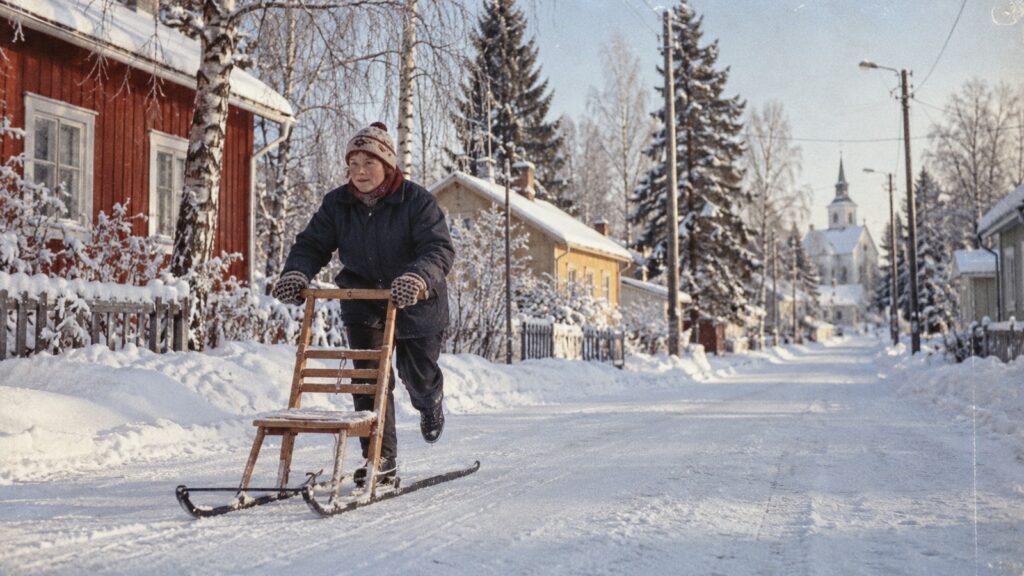
Many Finns know the kicksled from village roads, frozen lakes and the wall of grandma’s house. But the story of the vehicle does not begin in Finland alone. According to the Salo Historical Museum, the kicksled developed from a Swedish sled tradition and arrived in Finland in the late 19th century.
Finnish development work made it practical
Finns did not just admire the import. According to the museum’s collection highlights, Oskari Terhi, an electrical technician from Salo, developed a model running on iron runners in the early 20th century and refined its structure and steering. Handicraft teacher Vera Hjelt also played a part in spreading the skills needed to build kicksleds.
The kicksled became especially common at a time when getting around in winter meant work, shopping trips and hauling goods. The seat is not just a comfortable decoration: you could also load it with cargo.
Why do people still remember it fondly?
The kicksled is a textbook example of understated design. The rider provides the speed, the runners glide and the frame gives support. Nothing on it could ever be updated from the cloud.
A traditional kicksled does need the right surface, though. In soft snow, the runners do not glide the way they do on smooth, hard ice. When travelling on frozen lakes or rivers, the ice must be checked separately – a kicksled does not make thin ice safe.
The kicksled in village traffic
The kicksled was especially useful where winter routes stayed hard and the snow was packed. It was good for short trips and for carrying light loads. From today’s perspective, it resembles a city bike or an e-scooter: the journey may not be long, but the vehicle saves effort compared with walking – at least in the right conditions.
Part of the kicksled’s appeal is its form. The runners, seat, handles and wooden frame are all on display. Nothing hides under a casing. If it stops gliding, you notice the problem immediately. The history of winter travel is still best told through local conditions, though: a slushy southern Finnish winter and a hard-packed northern trail are not the same operating environment.
Hilavitkutin’s reality check
If the kicksled were judged by today’s startup metrics, its battery life would be unlimited and its server costs zero euros. The user experience would have one flaw, however: on uphill stretches, everyone has to pitch in.
In the end, that is the sled’s best feature. It never promises to do everything for its user.
Read more: Ice swimming safely: how to start Finland’s iciest winter hobby and Mölkky: how a set of wooden pins became an international Finnish success story. You can find every story in the series on our Finnish Oddities page.
Sources
- Salo Historical Museum – the history of the kicksled (in Finnish) (checked 1 Nov 2026)
- Visit Finland – weirdly wonderful competitions and events in Finland (checked 1 Nov 2026)