Anatomy of a puukko: from tang to pommel – and what Finnish law says about carrying one

Finnish tradition
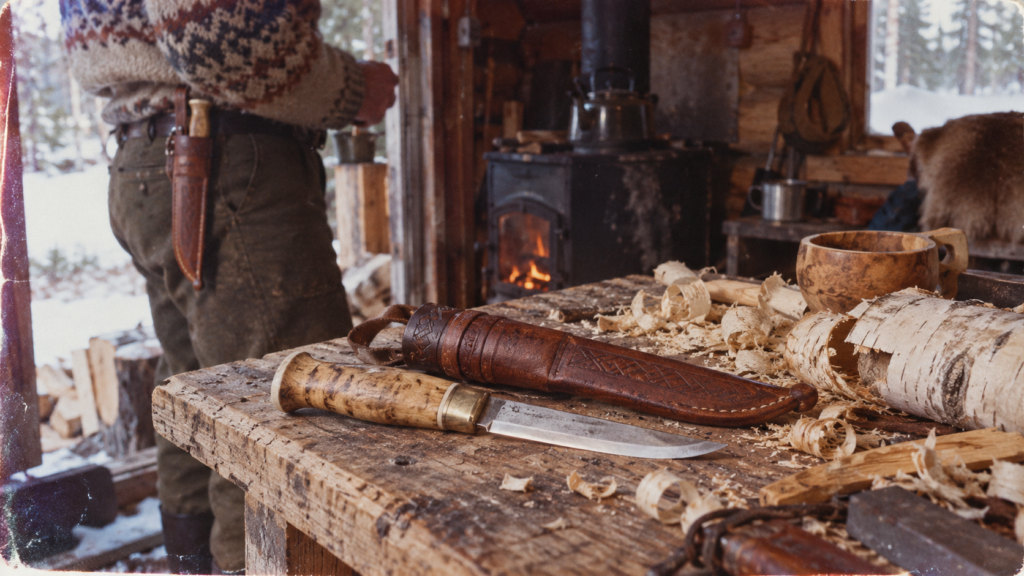
The puukko is the basic tool of anyone heading into the Finnish woods: a single-edged knife whose tang – ruoto in Finnish – is set into a handle roughly as long as the blade. Single-edged means the back of the blade is left unsharpened.
You’ll need
- A puukko and a sheath
- Time: 5 minutes to read, the rest of your life to practise
- Skill level: beginner
Step by step: the parts of a puukko
- Blade: the tang (ruoto, the part that goes inside the handle), the spine (hamara), the tip, the edge (terän suu, the sharpened part), the ricasso (palko, the unsharpened section at the base of the blade) and the bevel (lasku).
- Handle: the upper and lower ferrules (hela), spacers, an optional finger guard (väistin), the rivet and the pommel (ponsi).
- Sheath: the front panel (peili), the belt loop (kannike) with its rings, and the wooden insert (lesti).
- A finger guard stops your finger from slipping onto the blade but can get in the way when carving – a traditional Finnish puukko usually doesn’t have one.
Safety
Always carve away from yourself and keep the puukko in its sheath when you’re not using it. The law in Finland: carrying a bladed weapon in a public place without an acceptable reason is prohibited. According to the Finnish Police, since the reform of Chapter 41 of the Criminal Code that took effect on 1 January 2026, such cases are as a rule referred to the prosecutor and no longer end with an on-the-spot fine; the maximum penalty is one year in prison. A hike, fishing or work can be an acceptable reason – a city centre in the evening is not. This is a summary, not legal advice; check the current rules if you travel to Finland with a knife.
Tested by the editors: no – this article is based on the sources below.
Variations
Puukkos are often named after the place they come from: the Rautalampi puukko, the Vöyri puukko and the Tommi puukko are historical models. In Lapland there is also the leuku, a large knife used not just for carving but also like a machete or billhook. Kauhava is one of the traditional centres of the puukko industry, and in Rovaniemi the blacksmith Janne Marttiini founded his knife factory in 1928.
Sources
- Wikipedia (Finnish): Puukko – structure and names of the parts (checked 14 Oct 2026)
- Finnish Police: Possession of a bladed weapon in a public place will in future always lead to consideration of charges (5 Mar 2026, in Finnish) (checked 14 Oct 2026)
- Finlex: Public Order Act 612/2003 (in Finnish) (checked 14 Oct 2026)
- Marttiini: Story of Marttiini (checked 14 Oct 2026)
You may also like
- Weird & Wonderful
Beppe Borella’s marble toys: a block figure that weighs 35 kilos